



Guide to understanding credit card interchange rates, interchange plus pricing, and POS payment fees so you can control costs and protect your margins.
If you accept credit cards, you pay fees on almost every transaction. Most business owners see a percentage and a small per-transaction charge on their statement, but need more clarity on how those numbers are calculated.
This guide explains credit card processing fees, credit card interchange, how Visa and Mastercard set rates, and how interchange plus pricing works.
You will also see how the payment flow connects from the customer to your POS payment system and how to apply for merchant processing.
What Are Credit Card Processing Fees?
Every time a customer taps, dips, or swipes a card, several parties are involved.
The issuing bank that gave the customer the card, the card network such as Visa or Mastercard, the acquiring bank that sponsors your merchant account, and your payment processor all play a role.
Credit card processing fees are the total of three main parts: interchange rate, assessment fees, and processor markup.
In the United States, the average total cost for small and mid-sized businesses often ranges between 2.2 percent and 3.5+ percent per transaction, depending on card type, industry, and risk profile.
Debit cards with PIN typically cost less than rewards credit cards.
Card-not-present transactions, such as online or phone payments, usually cost more than in-person POS payment transactions.
Understanding Credit Card Interchange
Credit card interchange is the largest component of your processing cost. The interchange rate is set by the card networks and paid to the issuing bank.
It compensates the bank for fraud risk, handling costs, and the time value of money before the cardholder pays their bill.
Interchange rates vary based on several factors: card type, how the card is accepted, your merchant category code, and the amount of data submitted with the transaction.
For example, a regulated debit card transaction might have an interchange rate around 0.05 percent plus $0.22, while a premium rewards credit card could be 1.65 percent plus $0.10 or higher. E-commerce and keyed transactions often carry higher credit card interchange because of increased fraud risk.
Visa Interchange Fees Overview
Visa publishes interchange rate tables twice a year.
Rates differ for consumer credit, rewards credit, business cards, and debit cards.
For a typical small retail store using a chip-enabled POS payment terminal, a standard consumer credit card might fall around 1.51 percent plus $0.10. Premium rewards cards can be 1.65 percent plus $0.10 or more. Card-not-present e-commerce rates can exceed 1.80 percent plus $0.10.
Visa also charges assessment fees, which are separate from interchange. These are usually a small percentage of the transaction volume, such as 0.14 percent for credit transactions. Although these fees look small, they add up across thousands of transactions per month.
View and download Visa interchange rates.
Mastercard Interchange Fees Overview
Mastercard has a similar structure. Interchange rates depend on merchant category, acceptance method, and card type. A retail consumer credit card transaction may range from 1.58 percent plus $0.10, while higher-tier rewards cards can exceed 1.70 percent plus $0.10. Debit card rates are typically lower, especially for regulated debit.
Mastercard also applies assessment and network access fees, which are separate from the credit card interchange portion. When reviewing statements, business owners often see bundled charges, which makes it difficult to understand what is network cost and what is processor markup.
View and download Mastercard interchange rates.
What Is Interchange Plus Pricing?
Interchange plus is a pricing model where you pay the actual interchange rate set by the card networks plus a fixed markup from your processor.
For example, if the interchange rate for a transaction is 1.65 percent plus $0.10, and your processor markup is 0.50 percent plus $0.10, your total would be 2.15 percent plus $0.20.
This model is transparent because the interchange rate and the processor markup are separated.
It allows merchants to see exactly what portion goes to the issuing bank and what portion goes to the processor.
Interchange plus is common for businesses processing over $10,000 per month, but it is also available to smaller merchants through many providers.
How a POS Payment Transaction Works
Understanding the transaction flow helps clarify where fees apply.
Here is a simplified payment flow for an in-person POS payment.
1. The POS system processes the order then sends the transaction data to the payment terminal.
2. The payment terminal send data to the payment processor via payment gateway.
3. The processor routes the request through the card network, such as Visa or Mastercard.
4. The issuing bank approves or declines the transaction.
5. The approval travels back through the network and processor to your POS.

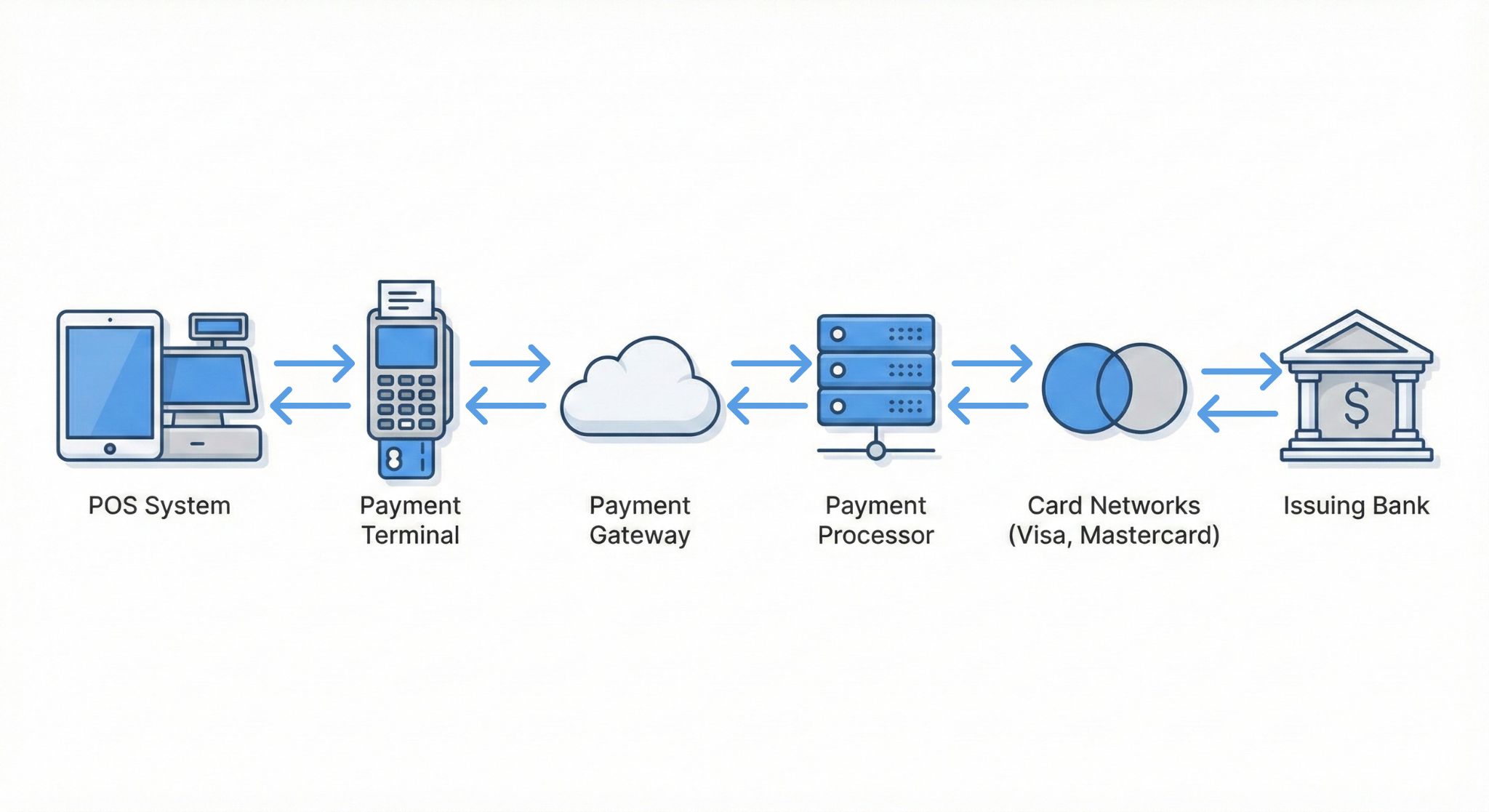
6. At the end of the day, your batch is settled and funds are deposited into your merchant bank account, usually within one to two business days. During settlement, the interchange rate and other fees are calculated and deducted. The net amount is what you receive in your account.
Why Interchange Rates Vary
Not all transactions qualify for the lowest interchange rate. Card-present transactions using chip or contactless technology typically qualify for better rates than manually keyed transactions. Submitting full address verification and security codes for online payments can also improve qualification.
Your industry matters as well. Restaurants, retail stores, professional services, and online subscription businesses all have different risk profiles.
The merchant category code assigned during your application influences which credit card interchange categories apply.
How to Apply for Merchant Processing
To accept cards, you need a merchant account. The process usually involves these steps:
1. Choose a payment provider that supports your business type.
2. Complete a merchant application with business details, tax ID, ownership information, and bank account details.
3. Submit supporting documents such as a voided check, business license, and recent bank statements.
4. Undergo underwriting, which reviews your business risk profile and projected processing volume.
5. Once approved, receive your POS payment hardware or gateway credentials and begin accepting payments.
Approval time can range from 24 hours for low-risk retail to several days for higher-risk industries. After approval, you will receive pricing terms, often expressed as interchange plus or flat-rate pricing.
How to Reduce Credit Card Interchange Costs
While you cannot negotiate the base interchange rate set by Visa or Mastercard, you can manage how transactions qualify.
Use chip or contactless readers instead of manual entry.
Ensure your POS payment system is up to date and supports proper data fields.
Review your monthly statements for hidden markups or non-qualified surcharges.
Choosing interchange plus pricing can provide clarity.
For higher-volume merchants, even a 0.10 percent reduction in processor markup can save thousands of dollars annually.
For example, on $500,000 in annual card volume, a 0.10 percent reduction equals $500 in savings.
Frequently Asked Questions
What is the average interchange rate?
The average credit card interchange for consumer credit cards in retail often ranges from 2.2 percent and 3.5+ percent plus a small per-transaction fee. Debit is typically lower.
Is interchange plus better than flat rate?
Interchange plus provides transparency and can be cheaper for higher-volume merchants. Flat-rate pricing offers simplicity but may bundle costs at a higher overall percentage.
Do Visa and Mastercard have the same interchange rate?
No. Each network publishes its own interchange rate tables, though they are often similar in structure and range.
How long does funding take?
Most merchants receive deposits within one to two business days after batch settlement, depending on the provider.
Can I negotiate credit card interchange?
You cannot negotiate the base interchange rate set by the networks, but you can negotiate your processor markup.
What is an alternative to Interchange Plus?
While interchange plus pricing offers transparency, some merchants look for ways to offset credit card interchange and reduce the impact of processing costs altogether.
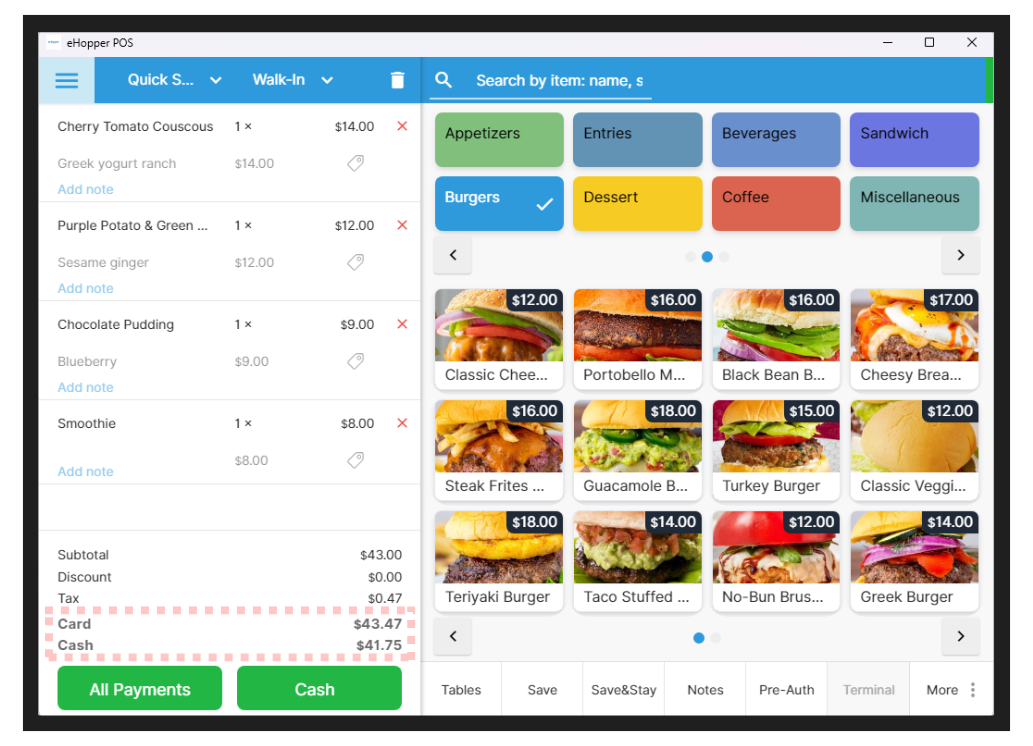
One alternative to interchange plus is a dual pricing program.
This model allows businesses to display one price for card payments and a lower price for cash payments, helping offset credit card processing fees in a compliant and structured way.

Next Steps: Take Control of Your Processing Costs
If you are reviewing your statements and wondering whether your interchange rate and credit card interchange charges are competitive, now is the time to act.
Start by requesting a statement analysis and compare your current pricing model to interchange plus options.
Ehopper can help you implement a complete POS payment system with transparent pricing and integrated merchant processing.
Whether you run a restaurant, retail store, or mobile business, a unified solution can simplify operations and give you better visibility into your payment costs.
Accept payments confidently, understand your fees clearly, and focus on running your business.
Checkout our free credit card processing calculator to estimate your monthly fees.
Take advantage of the eHopper POS offer, where you can get a feature rich eHopper POS system for free when you sign up for qualifying merchant processing.
Contact us to schedule a free demo and see how it can work for your business.